
Artificial Turf and Pavers: The Low-Maintenance South Florida Landscape
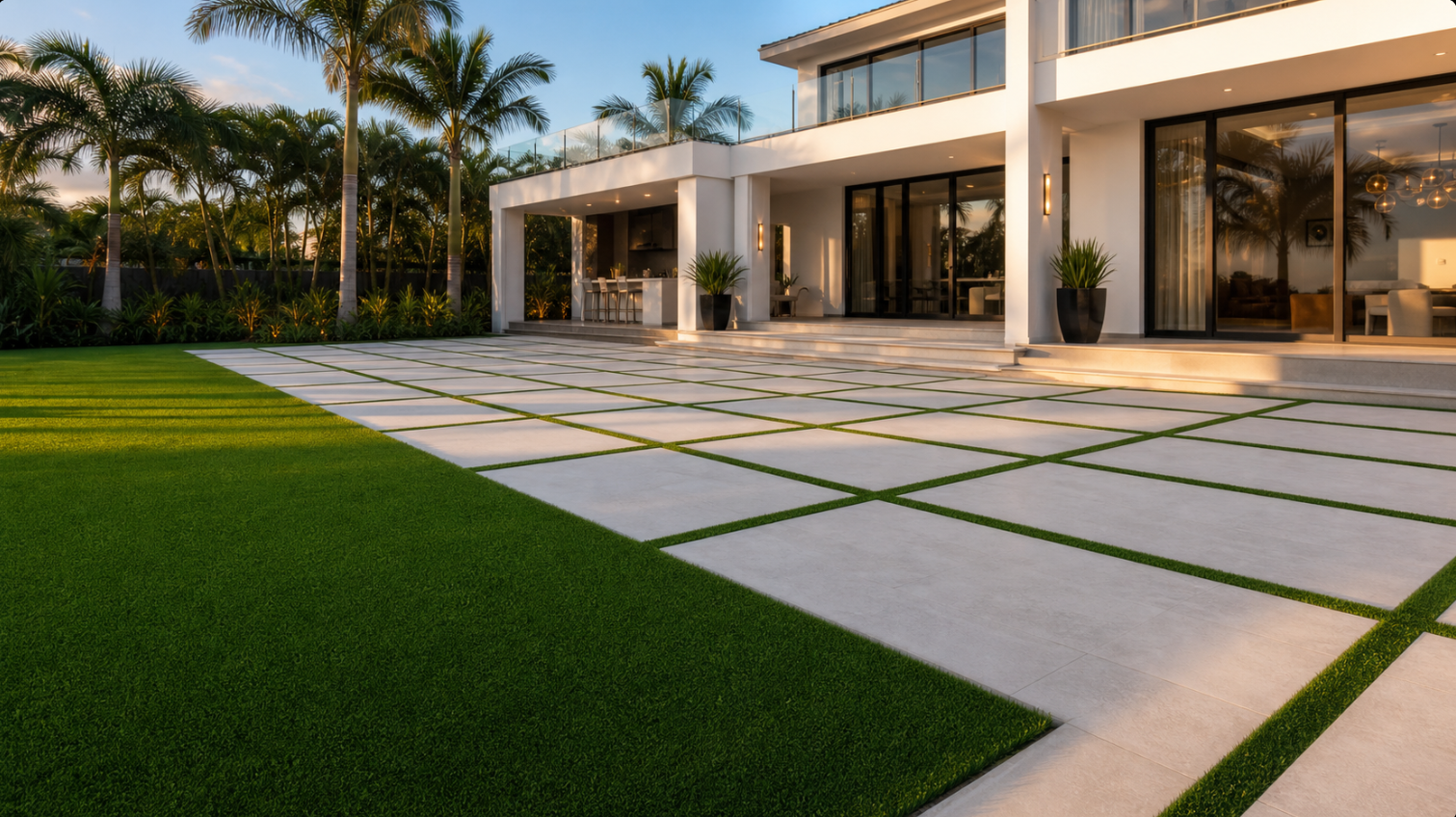
The pairing of artificial turf and pavers has become one of the most requested compositions in contemporary South Florida landscapes, and the appeal is easy to understand. Set clean bands of synthetic grass between crisp paver courses and you get a manicured, resort-quality plane that reads as intentional architecture rather than a patch of lawn. Done with restraint, artificial turf and pavers form an outdoor room with the discipline of an interior floor: geometry, rhythm, and a curated material palette that stays green through a Broward summer and a Palm Beach dry season alike.
Why South Florida Homeowners Want Artificial Turf and Pavers
Three practical pressures push this look forward here more than almost anywhere else.
The first is water. The South Florida Water Management District enforces year-round landscape irrigation limits under Chapter 40E-24 of the Florida Administrative Code, restricting watering to two or three days per week and prohibiting irrigation between 10 a.m. and 4 p.m. That rule is mandatory, permanent, and district-wide across Broward and Palm Beach. It governs living landscaping only. Artificial turf sidesteps the irrigation schedule entirely. For context on scale, the U.S. EPA's WaterSense program notes that outdoor use averages roughly 30 percent of household water, climbing toward 60 percent in arid regions, and that as much as half of landscape irrigation water is lost to evaporation, wind, and runoff.
The second is upkeep. No mowing, no fertilizing, no seasonal reseeding. For a second home or an estate managed at a distance, a surface that looks the same in July as in January has obvious value.
The third is the line itself. Pavers give a designer a hard, precise edge, and turf softens it without blurring it. The transition detail, where a sawn paver band meets a ribbon of green, is the craft of this composition.
The Heat Reality You Should Design Around
Here is the finding that responsible designers plan for rather than gloss over: synthetic turf runs dramatically hotter than natural grass or pavers in direct sun.
A Brigham Young University study (Williams and Pulley, Synthetic Surface Heat Studies) measured a synthetic field at about 86 degrees Fahrenheit hotter than adjacent natural turf under the same conditions, and recorded a peak surface temperature near 200 degrees on a 98-degree day. Penn State's Center for Sports Surface Research measured synthetic surfaces as high as roughly 159 degrees. A University of Missouri turf grass study found synthetic surfaces 50 to 70 degrees hotter than natural grass. A 2024 systematic review in the International Journal of Biometeorology examined 23 studies and concluded synthetic grass was hotter than natural grass in every sky condition tested.
Two details matter for design. First, this is a surface phenomenon: researchers noted that air temperature a few feet above the turf barely differs, so the heat lives underfoot. Second, hosing it down is not a fix. The BYU work saw a wet surface fall from 174 degrees to 85 degrees, then rebound to 120 degrees within five minutes and 164 degrees within twenty. Evaporative cooling is the only method shown to lower the temperature meaningfully, and the effect does not last.
None of this argues against turf. It argues for placing it thoughtfully. Homeowners who combine pavers and turf generally report satisfaction with the low maintenance and the clean look; the recurring complaint is exactly what the studies predict, that the turf gets hot underfoot in full sun.
Design Counsel: Combining Turf With Pavers
Treat turf as an accent material framed by cooler pavers, not as a wall-to-wall floor.
Use turf as ribbons and inlays. Narrow bands between paver courses, a geometric inlay inside a broad terrace, or a border strip reads as considered composition and keeps the barefoot walking plane predominantly paver. The paver band doubles as the edge restraint that holds the turf line crisp.
Respect full-sun, barefoot zones. Keep large turf expanses out of the immediate pool-deck traffic paths and the areas people cross barefoot at midday. Pavers, especially lighter tones, stay far more comfortable there. Reserve turf for spots the studies and homeowners both flag as lower risk.
Favor shade. Turf placed under a pergola, beside a shaded wall, or beneath tree canopy avoids the worst of the surface heat while still delivering the green.
Plan drainage first. South Florida's rainfall makes this non-negotiable. Installers typically build turf over several inches of compacted crushed-stone base with a geotextile weed barrier, and manufacturers state that turf backings drain freely. The sound engineering principle worth remembering is that system drainage is only as fast as its slowest layer, whether that is the turf backing, the aggregate base, or the outlet. A hardscape should also pitch away from structures, and pavers should be set to shed water rather than pond it.
Let pavers restrain the edge. Where turf meets the paver band, installers typically secure the perimeter with staples or nails and join seams with tape or adhesive. In a ribbon design the paver course itself becomes the clean, permanent boundary.
Honest Maintenance and Tradeoffs
Artificial turf is low-maintenance, not no-maintenance. The chief enemy in this climate is ultraviolet exposure, which fades and breaks down fibers over the years; South Florida's intense sun sits at the demanding end of that spectrum. Infill also migrates toward edges and thins over time and needs occasional topping up. Installers and manufacturers cite residential lifespans anywhere from roughly 8 to 15 years, with premium UV-inhibited systems claimed higher, though a hot, high-UV setting tends toward the shorter figures. And there is the heat, which is a design constraint rather than a defect. Weigh these against pavers, which age slowly, tolerate the sun, and can be refreshed course by course.
Where the Look Works Best
Artificial turf and pavers reward restraint. The composition is at its best as measured green geometry inside a larger field of pavers: a shaded courtyard inlay, a clean ribbon along a walkway, a low-traffic garden panel framed by stone. Kept out of the hottest barefoot zones and drained properly for our rainfall, it delivers the year-round manicured appearance estate and resort-style properties want, without the water bill or the mower.
Perfect Pavers of South Florida designs and installs both surfaces across Broward, Palm Beach. Explore our artificial turf and paver work, or contact us to plan the transition detail for your property.