
Permeable Pavers in South Florida: Drainage, Flooding & Driveway Guide
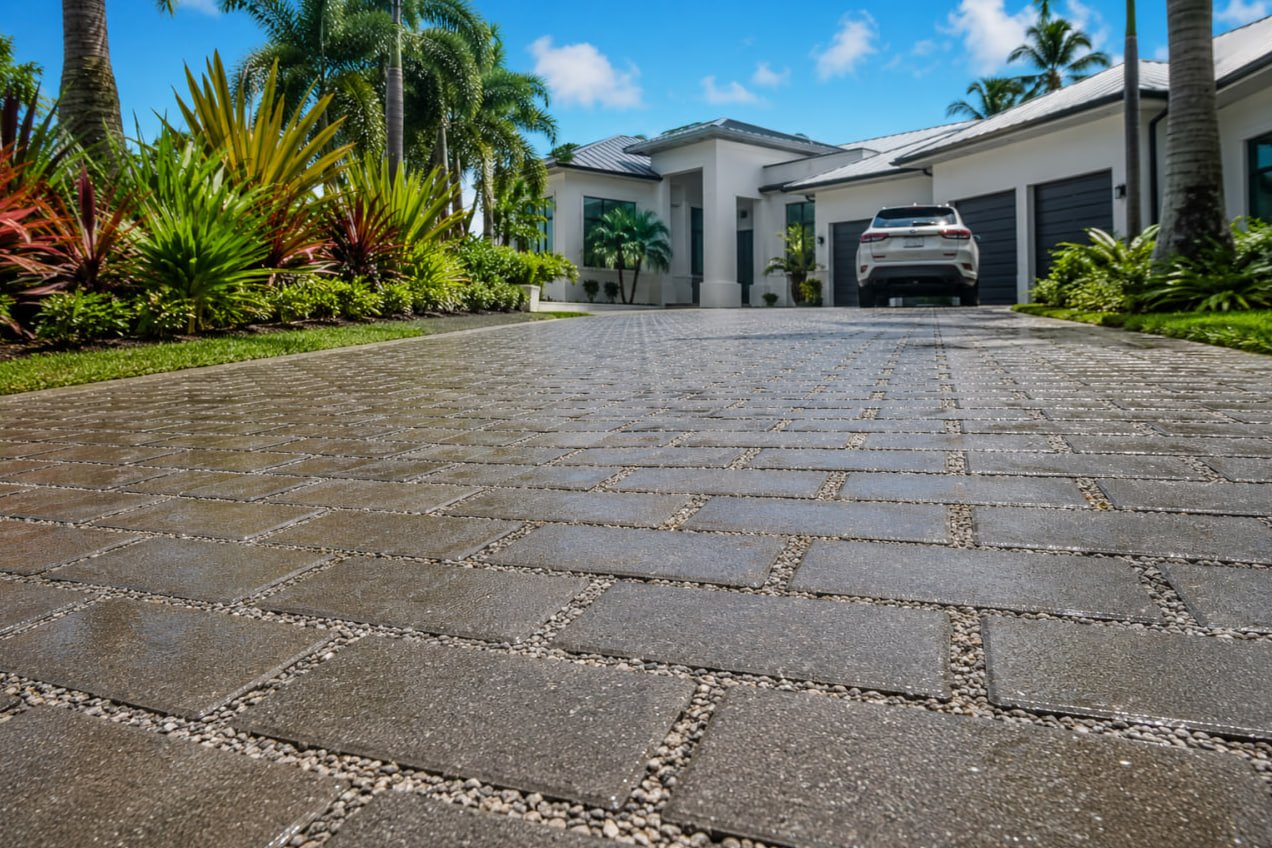
If you are looking at permeable pavers for a Broward or Palm Beach County home, the real question is not what they look like in a national catalog. It is whether they will actually move water in our conditions. South Florida gets hard, fast rain, and our water table sits close to the surface, so a driveway or patio that drains on paper can behave very differently in the ground here. Permeable pavers are designed to soak rainfall in place instead of shedding it to the street, which is exactly the pain point our yards feel. This guide explains how permeable pavers work, why our shallow water table is the deciding factor, and when they make sense for your property.
What are permeable pavers and how do they work
Permeable pavements let stormwater soak through the surface into a stone base and the ground below, instead of running off the way solid asphalt or concrete does. The U.S. EPA classifies them as green infrastructure and names three main types: porous asphalt, pervious concrete, and permeable interlocking concrete pavement, usually shortened to PICP. For residential driveways and patios, PICP is the one you will most often see, so it is the focus here.
Here is the part homeowners often get wrong: with PICP, water does not pass through the concrete paver itself. Per the EPA, it drains through the permeable joints between the pavers, which are filled with small open-graded stone, then down through a choker and bedding layer, into a base reservoir, and finally a subbase reservoir that both stores water and carries the load above. That layered stone section is the real engine. It is why a properly built permeable driveway can hold a burst of rain and let it seep away rather than pool.
How fast can it drain? Faster than our weather. The EPA reports that new permeable pavement can start with surface infiltration rates in the hundreds of inches per hour, and while those rates drop over time, they usually stay well above one inch per hour. A field survey of 11 sites cited by the EPA measured infiltration from about 5 inches per hour at the worst-maintained locations up to roughly 1,574 inches per hour. Even the low end far outpaces any rainfall intensity South Florida throws at a driveway. In other words, when these systems fail to drain, it is almost never because the design was too slow. It is because they were neglected, which we will come back to.
Why South Florida is different: the water table decides
This is the angle the big national manufacturer pages leave out, and it is the one that matters most here. A permeable system works by storing water in its stone reservoir and letting it seep into the soil below. If the ground is already wet close to the surface, there is nowhere for that water to go and nowhere to store it.
That is South Florida in one sentence. UF/IFAS guidance for Florida (publication AE530) calls for at least 2 feet of separation between the bottom of the permeable pavement system and the seasonal high water table. Where the water table sits near the surface, which is common across Broward and Palm Beach, that separation shrinks your usable storage and can rule out a simple full-infiltration design. UF/IFAS also says the system should drain completely within 24 to 72 hours so its storage is ready before the next storm, and that full-infiltration designs generally need soil beneath with at least 2 inches per hour of vertical infiltration. Below that, an underdrain or a lined, partial-infiltration design is typically required instead.
Regulation reflects the same reality. The South Florida Water Management District, which governs stormwater across Broward and Palm Beach, treats permeable pavement as a low-impact-development practice that can reduce a site's effective impervious area and even shrink the size of conventional drainage facilities. But SFWMD and UF/IFAS both stress that this only works where the water table and soil allow it, and it has to be evaluated site by site. The takeaway for a homeowner: permeable pavers can genuinely help with local ponding and flooding, but on some lots the high water table means a modified design, and on a few it means they are not the right tool. That is a determination made at your specific address, not from a brochure.
Is a permeable driveway right for your yard
Permeable pavers are a real option for driveways, but the sources are not perfectly aligned on how strong an option, so here is the honest picture.
The EPA states that permeable pavements can replace conventional impervious pavement in driveway, walkway, sidewalk, and low-speed applications, and can reduce ponding and local flooding by infiltrating rain on-site. On load, thickness does the work: the EPA notes PICP units are made thicker for vehicular areas, about 80 mm (3-1/8 inch), versus 60 mm (2-3/8 inch) for pedestrian areas. The Interlocking Concrete Pavement Institute (ICPI) goes further and lists residential driveways as a standard PICP application, and notes that federal FHWA guidance supports PICP for driveways, parking lots, alleys, and low-speed streets.
UF/IFAS is more cautious. Its Florida-specific guidance frames permeable pavement as best suited to light-duty traffic and is more reserved about driveways than the national industry standard. Both views are legitimate. The practical reconciliation is that a residential driveway carrying normal passenger vehicles is a recognized use, but it needs the thicker paver units, a base designed for the load, and, in our region, a design that respects the water table. The EPA is also clear on the hard limits: these systems are not as strong as conventional pavement, are wrong for extreme loads or fueling and chemical-storage areas, and any upslope runoff or heavy sediment source must be diverted so it does not clog the surface.
A quick way to gauge fit for your property:
1. Good candidate: a driveway or patio for normal vehicles or foot traffic, adequate separation above the seasonal high water table, and soil that infiltrates, where you want to cut ponding and street runoff.
2. Needs a modified design: a lot with a high water table or slow-draining soil, which often means an underdrain or a partial-infiltration system rather than simple full infiltration.
3. Poor fit: areas taking heavy or industrial loads, or spots that collect large amounts of sediment or runoff from higher ground that cannot be diverted.
Because a driveway replacement in Palm Beach can also trigger local drainage or swale requirements, this is worth walking through with an installer before you commit. Our driveways page covers where permeable systems fit alongside other materials, and the same reasoning applies to a patio or walkway.
Water quality: a real, measured benefit
Beyond draining rain, permeable pavers also clean it, and this part is measured rather than marketed. The EPA reports that PICP removes total suspended solids in the range of 67 to 81 percent, metals from 13 to 88 percent, and nutrients from 34 to 72 percent as water passes through the system. Porous asphalt and pervious concrete remove even more suspended solids. For a coastal region where stormwater runs toward canals and the ocean, keeping sediment and pollutants on your own lot instead of sending them downstream is a genuine environmental plus, not just a talking point.
Manufacturers lean into this. Brands like Belgard market permeable lines such as Aqualine and Aqua-Bric as reducing or even eliminating stormwater runoff, and Unilock offers a comparable Eco range, with several units approved for vehicular and driveway use. Those product lines are real and worth considering. Just treat phrases like "eliminates runoff" as marketing language: actual runoff reduction depends on your soil, your base storage, and that water table, and it is site-specific. Belgard also publishes a spec of more than 500 inches per hour of surface infiltration for its Aqualine series, but that is a manufacturer number for a new, clean surface, not independent field data, so read it as a spec-sheet figure rather than a promise for year five.
Maintenance: they clog, and that is manageable
The most common failure mode for permeable pavers is clogging. Fine sediment gradually settles into the joints and lowers infiltration over time. The reassuring part, per the EPA, is that studies show this generally does not reach full impermeability, and vacuum or regenerative-air sweeping can restore infiltration. So clogging is a maintenance item, not a death sentence.
There is an objective way to know when cleaning is due. Surface infiltration is measured with a standardized test, ASTM C1781, using a ring and a timed water pour, and ICPI publishes clear thresholds against it (Tech Spec 23). ICPI says to clean when measured infiltration falls below 20 inches per hour, or below 40 inches per hour on surfaces sloped more than 2 percent, or when more than 20 percent of the surface ponds during a storm or water stands longer than 15 minutes. Notice that even the "clean it now" trigger of 20 inches per hour is still many times any rainfall you will see, which is why a well-kept system keeps draining for years.
For routine care, field research referencing ASCE guidance recommends vacuum or regenerative-air sweeping at least twice a year, typically at the start and end of the high-debris season, and more often where nearby trees or erosion add sediment. ICPI also notes something specific to how these systems are built: PICP deliberately avoids the sand joints used in ordinary pavers, so sediment stays near the surface where it can be swept out. That means weeds growing in the joints are a sign of accumulated dirt and skipped cleaning, not a normal condition. Expect one more early task: ICPI notes the jointing stone usually needs a top-up 3 to 6 months after installation as the stones settle into the base, which is normal, not a defect.
This lines up with what real owners describe. On landscaping and DIY forums, homeowners with permeable paver driveways report the same pattern: joints collect dirt and organic debris, weeds appear where sediment builds up, and regular sweeping plus periodic joint-stone top-ups keep water draining. Sentiment is mixed, with people liking the drainage and look but noting the upkeep runs higher than a solid driveway. Those are aggregate impressions rather than a single verified account, but they match the ICPI maintenance facts closely: permeable pavers reward a little routine attention and punish neglect.
Bringing it together
For a South Florida property, permeable pavers are best judged on water, not looks. They work by soaking rain through open joints into a stone reservoir, and when they are sized right they drain far faster than our storms and even filter pollutants on the way down. The deciding factor here is our shallow, seasonally high water table, which UF/IFAS and SFWMD both flag as the constraint that sets your design and, occasionally, rules the system out. Driveways are a recognized use with the right thickness and base, though Florida guidance leans toward light-duty, and the ongoing trade is honest, planned maintenance to keep the joints open.
If you want someone to walk your specific lot, soil, and water table before you decide, see our driveways service, review the areas we serve across Broward and Palm Beach, or get in touch to talk through whether a permeable system fits your yard.