
Pavers vs. concrete: which one is the better choice for your home?
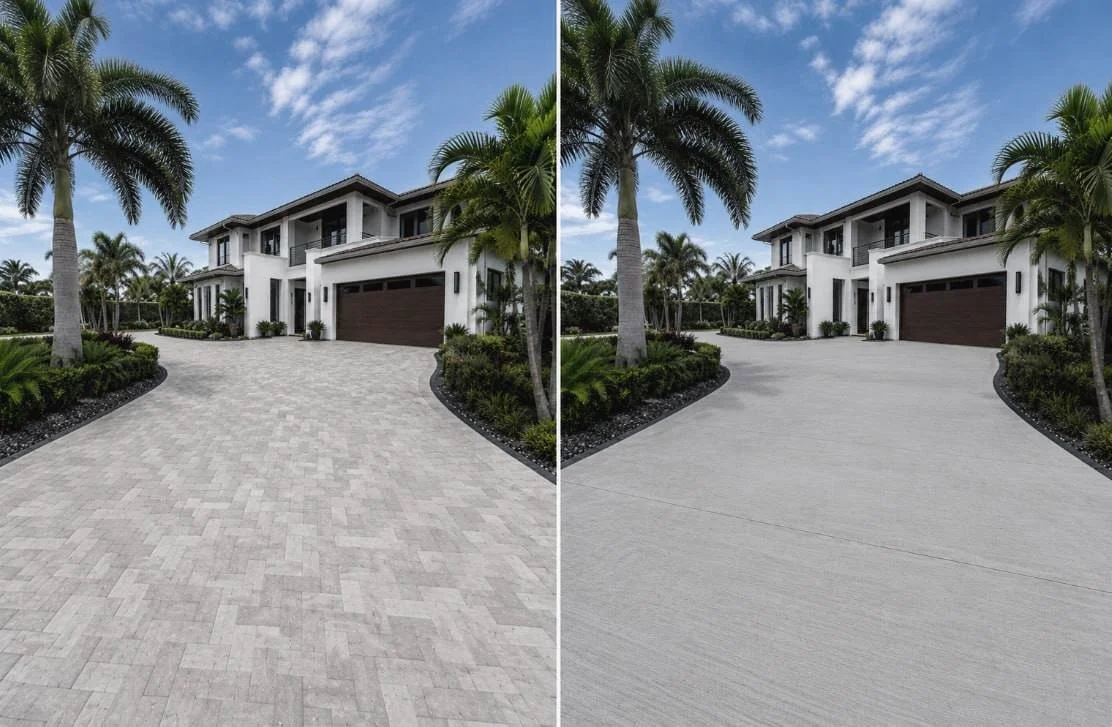
If you care about how your property looks and how it holds up over decades, pavers are usually the stronger premium choice. They are easier to repair, they come in far more design options, and they handle South Florida's shifting soil and heavy rain better than a poured slab. Concrete wins on speed and a lower upfront price, and it is a perfectly good material. The two just suit different goals.
Below is how the two compare across the factors that matter most, so you can match the material to what you want.
Upfront cost: what you pay to get it in the ground
On upfront cost, concrete wins, and by a wide margin.
Standard concrete usually runs about $6 to $15 per square foot. Stamped concrete costs more, around $12 to $20 per square foot once you add patterns and texture. Pavers sit higher at $10 to $30 per square foot, and premium natural stone or detailed patterns can reach $35 to $50.
Why the gap? The paver itself is a small part of the bill. Most of the cost is the work around it: excavation, a compacted gravel base, bedding sand, edge restraints, cutting units around curves and drains, laying out the pattern, and setting each piece by hand. Labor alone is about half the total. A poured slab goes down in one continuous pour. A paver surface is built piece by piece. That extra labor is exactly what makes pavers repairable and good-looking down the line.
Treat any per-foot figure as a rough estimate. Site prep, access, removing an old surface, and drainage work often move the price more than the material you pick.
Long-term value:
Upfront cost is the wrong number to focus on. What counts is the total cost over the life of the surface: repairs, refinishing, and the year you tear it out and start over.
Lifespan matters here. Well-installed concrete can last 10 to 20 years. Well-built pavers commonly last 30 years or more, and because they are individual units, a worn surface can often be re-leveled instead of demolished.
Over time the comparison shifts. Concrete lasts well, but once it cracks the repair shows, and the only real fix is replacing whole sections. Pavers cost more at the start, then come out ahead on premium homes over the years, because you solve individual problems without a teardown. For a home you plan to keep, the lifetime cost is the number to watch, not the install price.
Durability:
Every surface fails eventually. What sets them apart is how they fail and what that failure costs you.
Concrete cracks because it is rigid. When sandy soil shifts, a tree root pushes up, or the slab shrinks as it cures, the concrete has nowhere to move, so it fractures. Factory-made pavers are very strong by comparison. ASTM C936 requires concrete pavers to average at least 8,000 psi, with no single unit below 7,200 psi, while a typical residential slab is poured closer to 3,000 to 4,000 psi. Strength is not the whole story, though. A strong paver still settles on a weak base, and a well-reinforced slab on a good base can outlast a sloppy paver job. The base does most of the work either way.
Pavers settle too, and they are not magic. If the base is thin or the edge restraint is weak, they can rut, dip, or shift. The difference is in the repair. A settled paver section gets lifted, the base re-compacted, and the same units reset, often with no visible seam. A cracked slab stays cracked until you replace it.
Reparability:
This is the factor most homeowners underestimate, and it is where pavers pull clearly ahead.
Think about what happens over years of owning a home. A utility line needs digging up. An irrigation pipe bursts. A root pushes up a corner, oil stains one spot, or an area settles after a heavy storm. With pavers, you pull up the affected units, do the work underneath, re-sand the joints, and reset the same pieces. Done right, you cannot see the patch.
Now try the same repair on concrete. You saw-cut, patch, and then live with a section that almost never matches the original color or finish. You can see the repair. Over 20 years of ownership in this region, with hurricanes, settlement, and utility work close to guaranteed, repairs you cannot see are worth real money at resale and real curb appeal day to day.
Appearance and design:
Pavers come in far more colors, shapes, sizes, textures, borders, and patterns than any poured surface.
Standard concrete gives you gray, unless you pay for stamping, staining, or exposed aggregate. Those add cost and their own upkeep, and they can still crack the way any slab does. Pavers let you run a herringbone driveway, a contrasting soldier-course border, and a matching pool deck that all read as one designed exterior.
On an upscale property, that design range carries weight. It separates a surface that looks merely installed from one that looks planned.
Status and Curb Appeal
Pavers read as a higher-end property the moment someone pulls up. That perception has measurable weight.
Among real estate agents, 92% have advised sellers to improve curb appeal before listing, and 97% believe buyers find curb appeal important. A peer-reviewed study in the Journal of Real Estate Finance and Economics, which examined Google Street View photos and data from nearly 90,000 home sales, found that a property with strong curb appeal sold at about a 7% premium to a comparable home in the same neighborhood with weaker curb appeal. NAR has also estimated that certain outdoor upgrades, including hardscape like a stone walkway, can recover more than 100% of their cost at resale.
A paver driveway, walkway, and pool deck do exactly what curb appeal rewards: they make the first impression look finished and well kept. In competitive Palm Beach and Broward neighborhoods, that is often why owners choose pavers even when concrete would cost less.
Drainage and permeability
This matters more in South Florida than almost anywhere, because the local problem is too much water arriving too fast.
Standard pavers and poured concrete are both close to impervious: water runs off them. Permeable pavers let rainwater soak in where it falls, draining through the joints into a stone reservoir underneath, where it is stored and slowly released. The EPA lists permeable interlocking pavers and pervious concrete as surfaces that let stormwater soak in and sit in the gravel and soil below instead of running off. The benefit: permeable pavement reduces runoff and softens the impact of flooding in small and medium storms.
Two caveats. First, the performance comes from the base and reservoir design, not the surface alone. Second, permeable systems need routine cleaning, or the gaps silt up and stop draining. Pervious concrete exists as well, so pavers do not own this advantage outright. Still, segmental permeable pavers are the most common option and the easiest to maintain unit by unit.
Heat and barefoot comfort
Where people walk barefoot on pool decks in July, surface temperature matters a lot.
Color affects this more than the material does. Dark pavements absorb 80 to 95% of sunlight and get hot. An EPA-cited Arizona study found dark conventional surfaces reaching up to 152°F at midday, while cooler, more reflective surfaces stayed 10 to 16°F lower. Solar reflectance, also called albedo, is the main factor that sets how hot a surface can get.
For South Florida, that means dark concrete and dark pavers both run hot, while light-colored pavers such as travertine or pale concrete stay noticeably cooler. On a pool deck or a patio you spend time on, a light paver is the comfortable pick. On a driveway you only walk across, it matters less.
Maintenance:
No surface is zero maintenance, the two simply need different things.
Concrete needs the least day to day. You clean it and maybe seal it. But once it cracks or stains, restoring the look is hard, and the repair usually shows.
Pavers need steady light care: sweeping, the occasional top-up of joint sand or polymeric sand, weed control in the joints, and resealing every few years depending on the product and exposure. The upside is that this care keeps the surface even, and any damaged area gets fixed in place without a patchy look.
In short: concrete needs less routine upkeep but is harder to restore after damage, while pavers need more regular attention but stay easy to keep looking uniform.
Installation time and disruption:
If you need the job done fast, this favors the poured option.
Concrete is quick to pour, but it needs curing time before traffic, often several days before full use. Pavers take more labor and precision: excavation, base, screeding, setting, cutting, compacting, and jointing. That hand-built process is the reason they cost more and the reason they repair so cleanly later. Speed is a fair reason to choose concrete, and it is worth weighing.
Safety and surface performance:
Safety comes down to two things: not slipping, and not tripping.
For slip resistance, the deciding factor is surface texture, not the material name. ADA guidelines call for a wet-condition coefficient of friction of at least 0.60 on walking surfaces, and finishes such as broom-finished concrete, exposed aggregate, and brushed pavers are chosen against those friction results. Textured concrete and textured pavers both grip well, while smooth or polished surfaces, including glazed tile and smooth-troweled concrete, turn dangerously slick when wet. A broom-finished slab can be as safe as a textured paver, and a smooth, over-sealed paver can be as risky as polished concrete. Pick the finish for the location, especially around pools.
Trip risk is the second part, and here pavers have a practical edge. Settlement, pooling water, and broken edges create trip hazards on any surface, but a settled paver can be reset level, while a heaved or cracked slab leaves a permanent lip until you replace it.
Why South Florida shifts the decision
This region is hard on paving, and local conditions affect the choice more than the spec sheet does.
Salt air and chlorides near the coast are a real durability factor. In marine settings, chloride ions work into concrete and, once they reach embedded steel, break down the protective layer on the reinforcement and cause corrosion, which is a leading cause of concrete failure. A lightly reinforced residential driveway is lower-stakes than a bridge, but the principle holds: near salt water, reinforced concrete carries a corrosion risk that a segmental paver system avoids, because pavers rely on interlock rather than embedded steel.
Then add the rest of the South Florida list: heavy, concentrated rainfall that needs somewhere to go, sandy and shifting soils that cause settlement, strong UV that ages dark surfaces and fades finishes, and hurricane and flood disruption that makes drainage and easy repair worth a lot. Each of those favors a flexible, repairable, draining system. That is the practical reason pavers are so common on higher-end Broward and Palm Beach homes, even where concrete would cost less.
Best use cases
Choose pavers when you want premium curb appeal, design flexibility, repairs you cannot see, better tolerance for soil movement and heavy rain, and a surface that supports the home's value. That fits status-conscious owners, pool decks and patios used daily, and homes you plan to keep or sell at the top of the market.
Choose concrete when your top priority is a clean, low-fuss surface at a moderate price, the base and drainage are excellent, and you accept that a future crack will show. It is a solid, practical mid-range choice, and decorative finishes can dress it up if the budget allows.
Final recommendation
If you only want the cheapest usable surface and you are fine with upkeep and visible repairs, concrete will serve you well. If you want the property to look finished, stay premium, repair cleanly, drain well, and hold its value through years of South Florida sun, rain, and storms, pavers are the stronger long-term investment. Concrete is a good material. The point is simply that South Florida's conditions make a flexible, repairable, draining system the smarter choice for many homes, above all the ones where presentation matters.
Sources: National Association of Realtors, 2023 Remodeling Impact Report: Outdoor Features · Johnson, Tidwell & Villupuram, Valuing Curb Appeal, Journal of Real Estate Finance and Economics · ASTM C936 Standard Specification for Solid Concrete Interlocking Paving Units · US EPA, Types of Green Infrastructure