
Pavers Ideas
Driveway Paver Color Blending: Review the Installed Field

Approve driveway paver color blending by looking across an installed field from the places you will normally see it. Check whether lighter and darker units feel distributed throughout the surface, whether any patch pulls your eye away from the overall pattern, and whether a dark band belongs to the planned border. Agree on an early field review before installation advances, while there is a clear opportunity to discuss concerns.
For a Fort Lauderdale home, that review belongs in the conversation about driveway pavers installation. A chosen color name tells you what to order; it does not settle how the finished expanse should look.
Hero image: AI-generated illustration of color distribution and a contrasting border, not a completed project or evidence of a construction method.
Distinguish the product blend from the installed arrangement
A manufacturer’s named blend and a combination of separately ordered colors are different decisions. Establish which one your proposal describes. With a named blend, ask what range the product is intended to show. With separate colors, ask the installer how the agreed combination will translate into a field that can be reviewed on site. Do not invent a percentage from a handful of attractive pieces.
The homeowner’s task here is to describe the appearance being approved. You might want gentle variation throughout the field, or a more pronounced contrast with a quiet border. Make that preference clear without expecting every small area to contain an identical selection of shades.
If the product itself is still undecided, our guide to reviewing driveway paver samples in Pompano Beach covers that earlier step. Once the choice is settled, shift attention from individual pieces to their relationship across the installed surface.
Read the field at the scale of everyday use
Start from a normal approach to the house, using a safe viewing position agreed with the installer. Then look from the front entry and garage. A close view helps you describe particular units, but the wider view reveals whether the driveway reads as one composition. Avoid judging the whole layout from a tight phone crop.
Look for shapes made by color rather than joints. Does a group of dark units form an unintended island? Does a pale strip appear to divide the driveway? Does a shift remain noticeable when you change your viewing position? These observations give the installer something specific to examine. They do not establish a cause or a defect.
Judge the border separately. A continuous charcoal band can be an intentional frame, while a similarly dark group in the center may be something you want to discuss. Check the agreed layout before asking for either to change. A decorative border’s appearance also does not tell you how the edge is restrained below or beside the surface.
Where a driveway connects visually with a courtyard, discuss that transition within the patio pavers installation plan. Decide whether the adjoining areas should share the same visual character or have a deliberate boundary. A continuous view deserves a coordinated decision.
Discuss how material will reach the installed field
CMHA’s Construction of Interlocking Concrete Pavements recommends drawing units from several bundles during installation to blend color. It applies that advice even to a nominally single color, where slight variations can still be visible.
Ask the installer how that guidance relates to the selected product and the planned sequence. The useful answer connects the delivered material with the appearance you expect to review. It should leave you knowing whom to contact if an emerging section looks different from what was discussed.
Keep material handling with the crew. You do not need to move heavy bundles or sort stock yourself to participate in an appearance decision. Your contribution is to notice the field, identify a concern clearly and bring it to the person responsible before it gets lost in the day’s work.
Agree when the first field review will happen
CMHA’s Guide Specification for the Construction of Interlocking Concrete Pavement describes representative samples and an accepted mock-up as references for judging the work. It is an editable guide specification with placeholders, not local law or an automatic requirement in your contract. Its reference approach can inform a project discussion without making its example dimensions mandatory.
Agree with the installer on an early review point that shows enough continuous field, including the intended border, to discuss distribution meaningfully. Let the installer identify when this can happen within the work sequence and where you can safely observe it. A few isolated pieces cannot answer the same question as a connected area.
Settle who will attend, who can approve the appearance and what happens if that person is unavailable. If work is expected to wait for an appearance decision, put that arrangement in writing before installation starts. Do not assume that a casual request to look later creates a pause in the schedule.
Request a consultation with Perfect Pavers to discuss the proposed blend, border and everyday viewing positions. Use the meeting to establish a practical field review point, then ask for a written scope identifying the review area, decision-maker and how unresolved appearance concerns will be handled.
Record a concern in comparable conditions
Photograph the field dry, in comparable daylight, from the same positions. Keep a wide view showing where the area sits and a closer view showing the units involved. Turn off filters and avoid comparing a shaded morning picture with a bright afternoon image as though the lighting were unchanged. A palm shadow can resemble a dark patch while crossing several differently colored units.
Describe what you see with a location and a visual observation. A darker group beside the garage is more useful information than a claim that the whole delivery is wrong. Refer to the agreed appearance record and ask for an on-site review. Photos support that conversation; they cannot promise an exact color match or diagnose a manufacturing defect.
If a change is proposed, have the installer explain its limits and any effect on the work or schedule before you approve it. Record the agreed response and revisit the area together. Leave any lifting or rearrangement of installed units to the crew.
Use the regional project record within its limits
Our published Pompano Beach pool deck and driveway pavers project documents base reconstruction, a drainage slope and secured edge restraints. Those construction details matter alongside the appearance discussion, but they do not establish a particular bundle-mixing method.
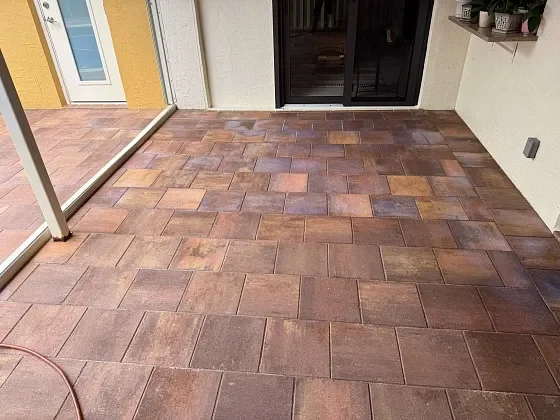
Actual project photo: the screened terrace within the documented project, not a driveway photograph.
The terrace photograph shows warm red, tan and brown rectangular units together across a surface. It offers a way to discuss how multiple tones read at field scale. It cannot prove how the crew selected individual units, and it does not promise that another product or installation will reproduce the same appearance. Keep the visual reference and the documented construction scope distinct.
Make the appearance decision specific
An early review is useful when everyone understands what was accepted and what remains unresolved. Record the area reviewed, the date, the reference photos and any agreed follow-up. Approval of the color distribution should be described as that particular decision, rather than left as a vague approval of everything visible or hidden in the driveway.
Arrange a driveway pavers installation consultation for your Fort Lauderdale or Broward County home. Discuss the distribution you want to see across the installed field, then request a written scope that connects the selected materials, intentional borders, review point and approval responsibilities before work advances.