
Pavers Ideas
Comparing Paver Driveway Quotes: What Must Match
Compare driveway replacement quotes by making the work match before judging the totals. Both proposals should refer to the same drawing, boundaries, pavers, pattern, removal, base work and connections to existing surfaces. Then separate work included at the stated price from allowances, exclusions and conditions still awaiting assessment. Send the same clarification questions to both bidders. A lower total alone does not establish inferior work, and a higher total does not establish a more complete scope.
For a South Florida project, the written driveway pavers installation scope should let you trace each price to an identified area and task.
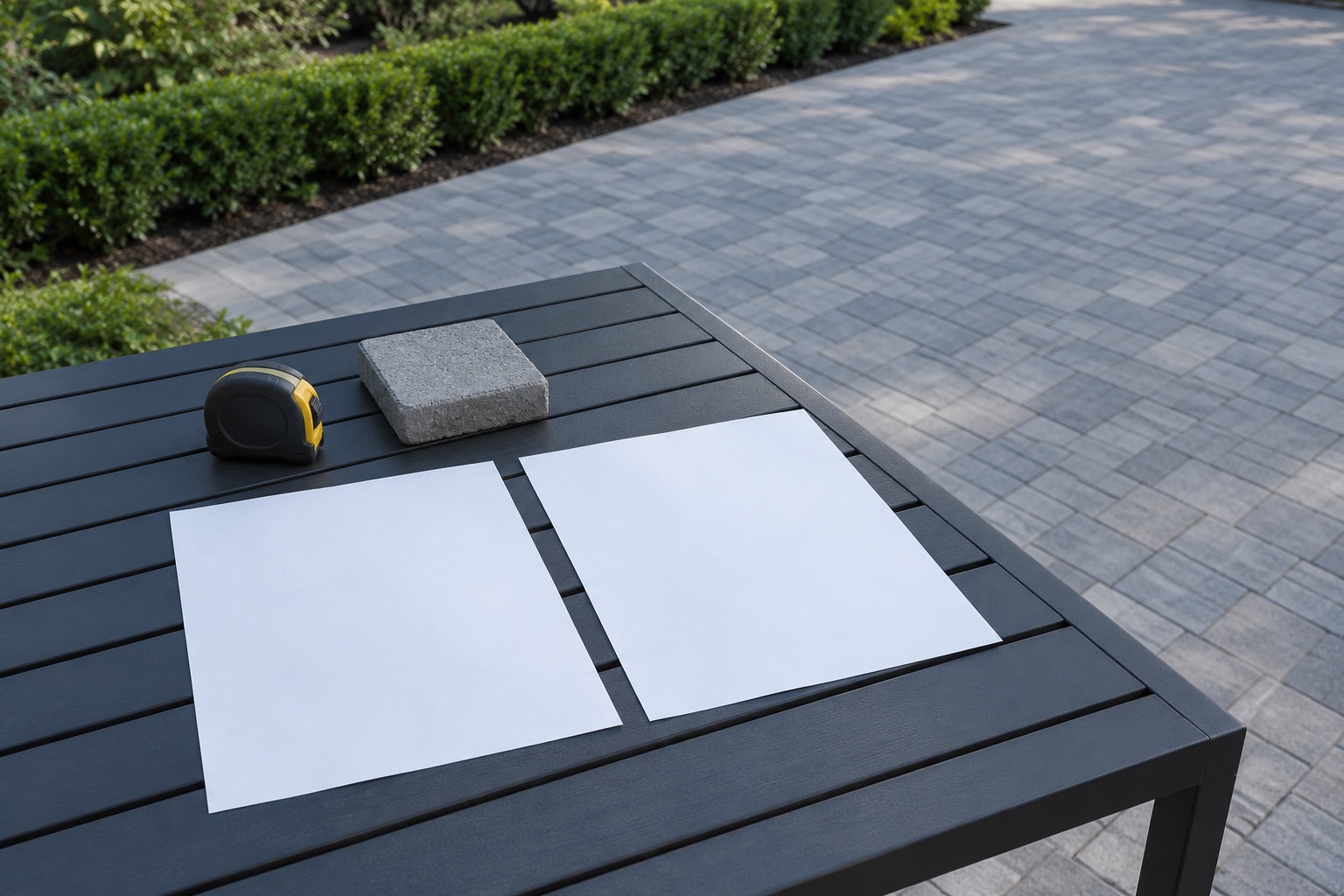
AI illustration of comparing driveway proposals at an outdoor table, not a completed project or an installation detail.
Put both quotes against the same drawing
Use a dated drawing or marked site plan as the reference for both proposals. Identify the driveway footprint, edges that will move, surfaces that will remain and the limits at the street, garage and front walk. Ask both bidders to confirm that their quantities refer to those boundaries.
Check whether a quoted area includes borders, connecting paths and any section beyond the main parking area. If the area figures differ, request an explanation tied to the drawing. Do not resolve the discrepancy by choosing whichever measurement makes the total look better.
Keep alternatives separate. A driveway widened toward the hedge is a different scope from replacement within the existing outline. Ask for the common replacement scope first, with the widening identified separately if you still want to consider it.
Match the actual product and layout
Record the exact product identification, material, color, finish, size and thickness in each proposal. A general description such as gray pavers leaves too much open. Ask each bidder to confirm suitability for the proposed driveway use, without treating a similar appearance as proof of equivalence.
Compare the laying pattern and its direction, the border product and arrangement, and any contrasting bands or inset features. Have the drawing show where those details occur. Check whether cuts and transitions needed for that layout are covered by the stated price.
If the products differ, request the same selection from both bidders or a clearly identified alternative. Keep any proposed substitution subject to written agreement.
Separate removal from the work beneath it
Find the removal line in each quote. What existing surface and underlying material does it cover? Is hauling and disposal included? Ask what remains on site, whether any units are to be retained, and who handles them. A removal description should connect to the same marked limits as the new work.
Next, compare what each proposal says about retaining, repairing or rebuilding the base. Ask for the proposed materials, extent of work and site assumptions. If one quote describes preparation only generally, request the detail needed to compare it with the other.
CMHA’s Construction of Interlocking Concrete Pavements describes stages including layout, excavation, soil preparation, base construction, edge restraints, bedding and placement of concrete pavers. Surface units are one part of the construction scope.
Ask each bidder what remains unassessed beneath the existing driveway and how that uncertainty appears in its price. Our guide to what a driveway estimate site visit reviews provides background on the assessment; your comparison needs the resulting assumptions recorded in both proposals.
CMHA’s Operation and Maintenance Guide for Interlocking Concrete Pavement distinguishes cosmetic concerns from distress affecting structural performance and relates remedies to the identified problem. Appearance alone does not establish which remedy a driveway needs.
If the bidders propose different base work, ask each to explain the condition it is addressing. Keep that question open until the difference is understood.
Check the garage and walkway connections
Ask how the proposed finished surface meets the garage entrance and the retained front walk. Identify any adjustment to adjoining surfaces, drainage features or edge restraints, and whether that work appears in the price. A note about finishing neatly does not identify which adjoining work is covered.
Where the project includes walkway and driveway pavers, show the dividing line between replacement and retained areas. Have both proposals state whether the connecting path is included and how its product and layout relate to the driveway. Review the transition itself, even if the path stays.
Include protection, restoration, delivery and access
Ask both bidders to identify the landscaping, irrigation, existing surfaces and nearby features that their work would affect. Compare the protection they propose and the restoration they include. Record which disturbed areas would be restored, with what materials, and which remain the homeowner’s responsibility.
Then review delivery, unloading and material storage. Does each proposal include the handling required for the access available at your property? Ask where materials and removed debris would wait, and whether the price assumes an access route you can actually provide.
Clarify how the household will reach the entrance during work and how vehicle access will be discussed as the job progresses. If either proposal depends on access through an adjoining area, resolve that assumption before accepting its price.
If one quote includes restoring the lawn disturbed by removal and the other mentions cleanup only, ask the second bidder whether lawn restoration is included. Ask the first to confirm its restoration boundary. Carry both answers into the revised proposals; do not assume those descriptions mean the same thing.
Request a consultation with Perfect Pavers for a site assessment and an itemized proposal. Bring the marked drawing and your unresolved comparison questions. The next step is to review those questions on site and ask that the proposal identify the work, assumptions and remaining uncertainties discussed.
Mark what is included, provisional or outside the quote
For each line, ask both bidders to make its pricing status clear:
- Included at the stated price: identify the exact work covered and the assumptions attached to it. Check that an item mentioned in the description also belongs in the total.
- Stated allowance: ask what the amount covers, what remains undecided, and how the final amount would be established. Confirm whether the allowance is already included in the quoted total and how an adjustment would be approved.
- Excluded or unassessed: mark these separately. For excluded work, identify who would arrange and price it. For an unassessed condition, ask what information is needed before its scope and cost can be established.
Read the exclusions beside the main description. Ask specifically about any sealing, drainage alterations, utility work or landscape replacement discussed but left unclear. Do not treat a blank line as included work or silently add your own estimated cost to fill it.
Use the project example for the right question
Our published Pompano Beach driveway and pool deck project records base reconstruction, slopes for drainage and secured edge restraints alongside the pavers in both areas. It demonstrates why a proposal deserves review beyond the surface units.
The record does not document competing quotes, savings or a hidden problem discovered on that job. For your comparison, use it to ask where each construction element appears in the proposals, rather than assuming your driveway needs the same scope.
Agree on changes before choosing a proposal
Ask both bidders to describe how variations would be handled. Require written agreement on a proposed change’s work limits, price and schedule effect before authorizing that variation. This applies to a product substitution, a design revision or additional work proposed after removal.
Give each clarification question a location and scope item so the replies can be matched without interpretation. When answers arrive, request updated proposals that incorporate them. Compare the same drawing revision and product selection, with allowances and exclusions visible beside the totals. Resolve contradictory wording instead of relying on a separate conversation to explain it later.
Review the clarified driveway pavers installation proposal against your original list. You should be able to identify what you are buying and which decisions remain open before choosing.
For a replacement driveway in Broward or Palm Beach County, contact Perfect Pavers to arrange a consultation and site assessment. Share your intended boundaries, product choices and unresolved scope questions, then request an itemized proposal reflecting that review so you can compare the defined work before proceeding.