
Pavers Ideas
New Pool Deck Pavers Next to an Existing Patio: Plan the Join
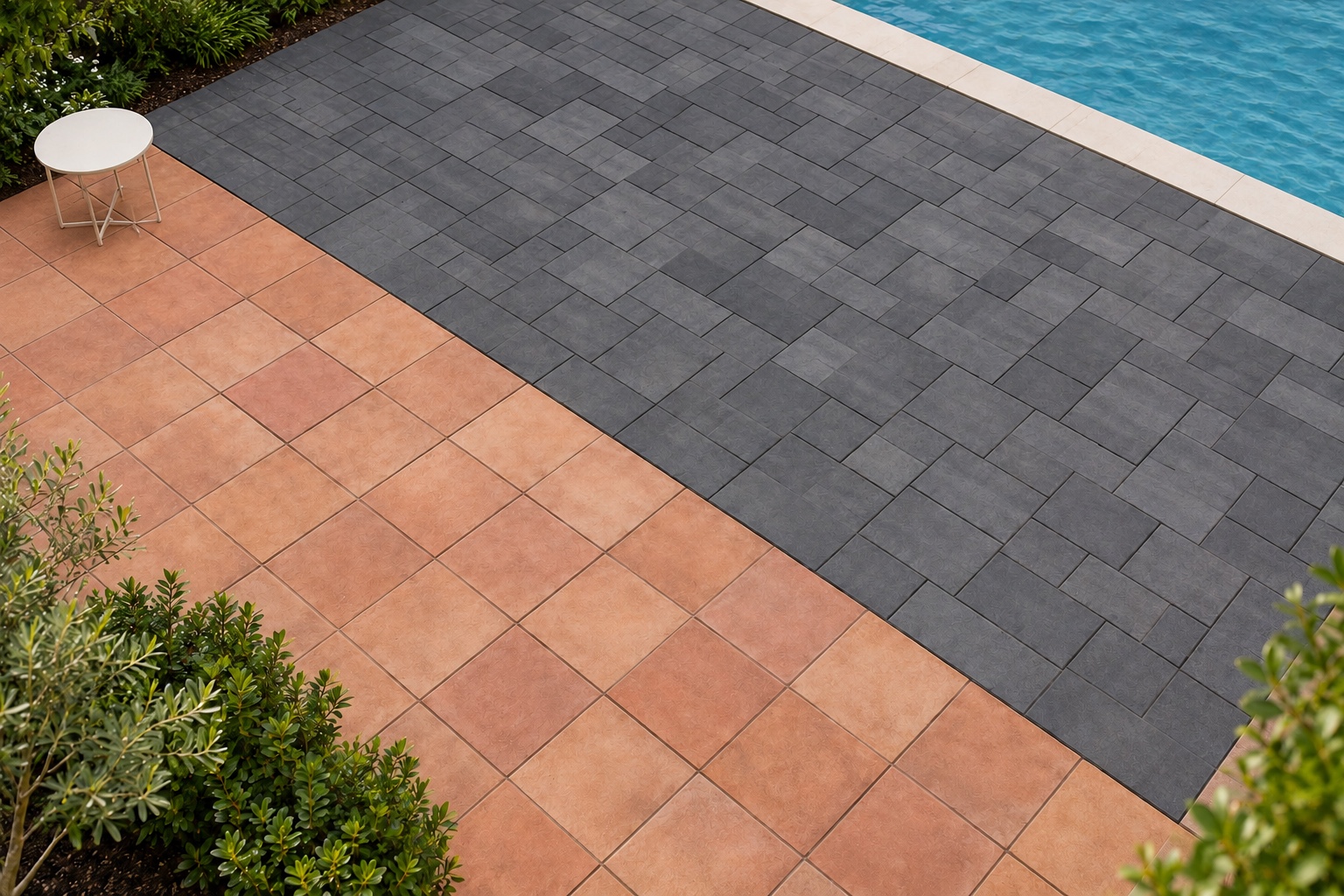
You can plan new pool deck pavers while keeping an adjacent patio, provided the retained edge, proposed finished levels and water route are assessed together. Define exactly where replacement stops, decide whether the materials should contrast or coordinate, and record existing movement before removal. Ask for a measured transition plan and named responsibilities for protecting or repairing the patio edge. Choosing a thinner or thicker paver alone does not establish a flush join, and concealed conditions may change the agreed scope.
For Broward homeowners considering pool deck pavers installation, the retained patio belongs in the initial assessment. It remains part of the finished outdoor space even when most of it sits outside the replacement contract.
AI-generated illustration: charcoal-gray rectangular deck pavers meet a retained terracotta-colored square patio. This is not completed work or a technical installation detail; the flush-looking join does not establish suitable levels for a real property.
Draw the boundary before choosing the pattern
Mark the proposed stop line on a photograph or sketch. Include corners, narrow returns and the route people use between the seating area and pool. A description such as replacing everything around the pool leaves room for disagreement where the deck blends into the patio.
Distinguish the patio field you intend to leave untouched from any edge pieces that may need lifting, cutting or replacement. Ask whether the proposed work can be assessed from the exposed surface and what remains unknown underneath. Keeping the patio should be a defined scope, not an assumption that every existing piece will survive undisturbed.
If adjustments extend into the sitting area, identify that portion as patio pavers installation work in the proposal. This gives you something specific to compare between estimates instead of discovering later that each contractor interpreted the boundary differently.
Choose a deliberate seam or a coordinated layout
A visible change can make the retained patio look intentional. Coordination can also work, provided you approve what the actual materials look like together rather than expecting a catalog color name to produce an invisible match.
| Approach | What to review before ordering |
|---|---|
| Deliberate material seam | Whether the contrast and boundary location look intentional from the seating area and across the pool |
| Coordinated colors and pattern | Whether the available pieces relate to the existing patio without depending on an exact color or joint-line match |
| Separate border treatment | Which side contains the border, how much retained material it affects, and who includes it in the scope |
View proposed samples beside the existing patio in ordinary daylight. Consider the whole outdoor space, including furniture, rather than judging only a close-up of the join. Ask to see where pattern alignment will stop and how the installer proposes to handle mismatched unit sizes. Approve the visual relationship separately from the construction detail.
Record what the retained patio already does
Photograph the boundary from both sides before materials arrive. Include chipped corners, open joints, displaced pieces and areas where you have noticed rocking during normal use. Date the record and describe whether a condition is longstanding, recent or uncertain. Do not deliberately load or disturb loose pieces to test them.
Add observations of water after ordinary rain: where it collects, crosses the proposed boundary or leaves a persistent wet area. Share previous repair records if available. These observations help frame the assessment; they do not establish the cause or a drainage design.
CMHA’s Operation and Maintenance Guide for Interlocking Concrete Pavement distinguishes visual distress from problems affecting structural performance and relates repair and reinstatement to the identified condition. Its guidance concerns interlocking concrete pavers; it does not diagnose your retained patio from photographs.
Ask the assessor to separate appearance you are willing to retain from conditions needing investigation before the deck replacement can be scoped.
Request a measured plan for the finished join
Have the proposal identify existing patio levels and the intended finished deck surface along the shared boundary, including its ends. Ask who takes the measurements, who prepares the transition detail and who checks it before installation proceeds. A statement that the surfaces will meet neatly is not a measured plan.
CMHA’s Construction of Interlocking Concrete Pavements addresses base preparation, bedding, edge restraints and finished elevations as coordinated parts of concrete pavers installation. It advises correcting an uneven base rather than compensating with bedding sand. These principles do not supply a universal detail for joining your deck to an existing patio.
Request an explanation of the complete proposed assembly, what stays beneath each surface and which assumptions require confirmation after removal. Have the responsible professional explain the intended water route across or alongside the transition. Leave elevation, drainage and joint specifications to the project team.
Arrange a consultation with Perfect Pavers and bring the boundary sketch, condition photos and material preferences. Ask the assessment to identify the measurements, retained-edge questions and specialist input needed for a written scope before you commit to an order.
Agree what happens when removal reveals more
Make the first exposed boundary a review point. Ask the contractor to document what removal reveals before proceeding with work that would alter the retained patio. The proposal should explain who contacts you, what revised scope you receive and how changes affecting cost or scheduling are approved.
Discuss the fallback if the edge cannot remain exactly as drawn. You might consider a wider area of reinstatement, a different visual boundary or a revised material choice. None should become automatic permission to replace the patio. Agree how the team will protect the unfinished area while a decision is pending.
Separate existing defects, newly discovered conditions and damage caused during the work. Ask who documents each, who handles repairs, and how repair costs and acceptable appearance will be agreed. A promise to be careful does not resolve responsibility for a chipped retained corner or unavailable replacement piece.
Keep pool-edge work distinct. Our guide to the joint between pool deck pavers and coping covers that separate assessment; a patio transition decision does not settle the coping interface.
Use a completed project to discuss scope
Our Pompano Beach pool deck and driveway installation records full installation across both areas, a rebuilt base, new pavers, slope for drainage and edge restraints. It demonstrates a coordinated scope covering the visible finish and supporting work.
The public description does not establish that an adjacent patio was retained. Use it to discuss how preparation and finishing belong in the same proposal, while asking for a separate explanation of your retained boundary. It cannot establish matching levels, concealed conditions or the outcome at your home.
Plan recovered pieces, spares and the walkthrough
Before removal, decide which recovered patio pieces should be set aside for assessment, where they will be stored and who determines whether they are suitable for reuse. Agree before unwanted material leaves the property. Salvage is a possibility to evaluate, not a promised supply of matching replacements.
For new pavers, discuss spare pieces and keep the product identification with the handover records. Separate new stock from recovered patio pieces so future repairs start with a clear record of what belongs where.
At the final walkthrough, compare the boundary with the approved sketch, material choice and recorded changes. Review the retained edge against the starting photographs. Have the responsible parties explain how they checked the finished levels, water route and transition detail. Record unresolved items, the person handling each and the follow-up arrangement.
For your Broward home, book a pool deck pavers consultation to assess the replacement area together with the patio you want to keep. Bring the record of existing conditions and ask for a proposal defining the join, remaining investigations and responsibility for reinstatement.