
Pavers Ideas
Reusing Existing Driveway Pavers: What to Agree Before Removal
You may be able to reuse some existing driveway pavers within a replacement project or an adjacent walkway, but agree on the arrangement before removal starts. The contractor must first assess suitability and accept the proposed reuse. Put the areas to retain, lifting and sorting responsibilities, storage location and fallback in writing. Treat the usable quantity as provisional until the pavers have been lifted and assessed. A request to save them is not a promise that enough will qualify.
For a South Florida home, make that decision part of the driveway pavers replacement scope, so the crew knows which materials require review before disposal.
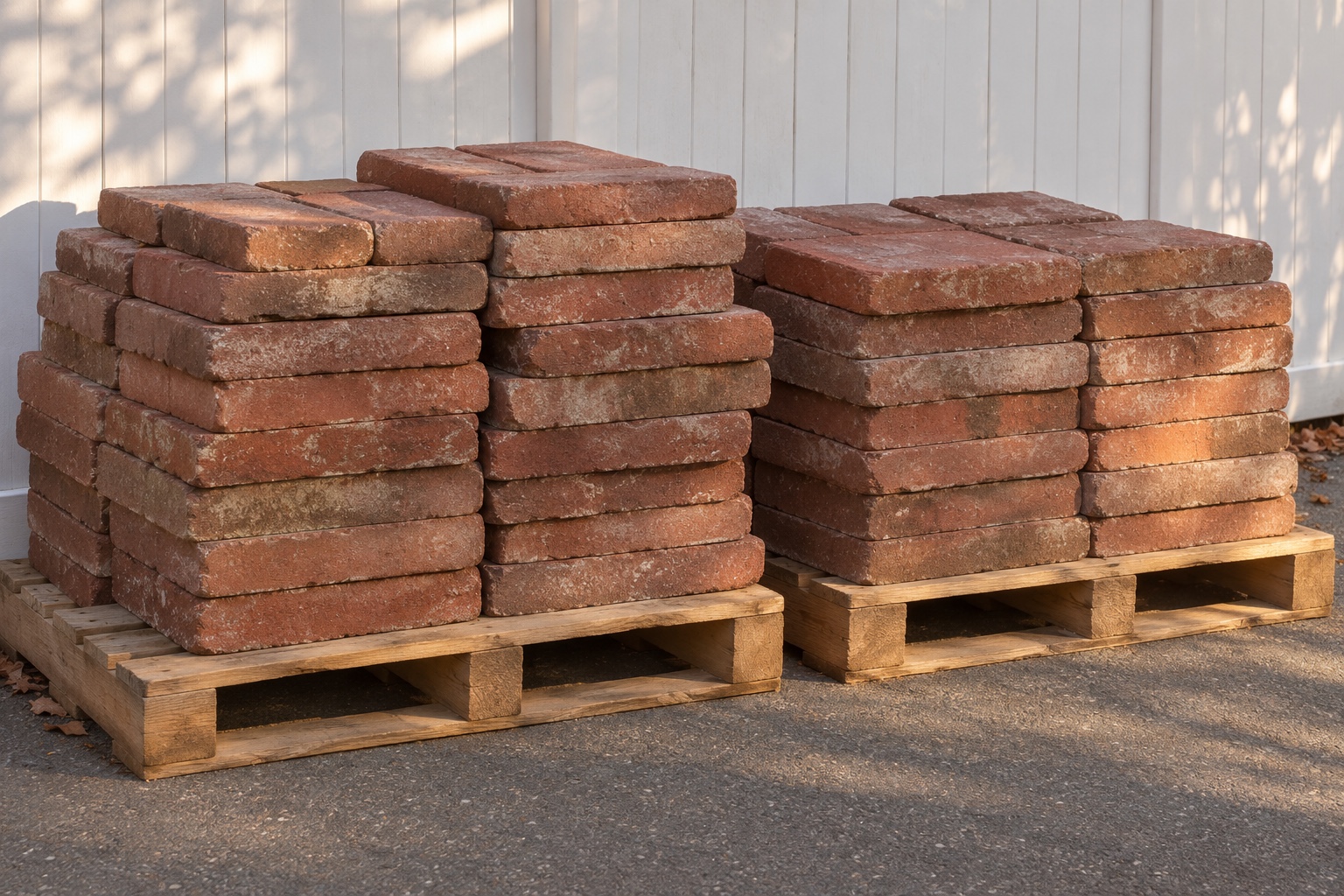
AI illustration of weathered concrete pavers stacked on timber pallets, not a completed project or an installation detail.
Name the destination and mark the removal zones
Decide what you want the retained pavers to become. They might occupy an agreed section of the replacement driveway or an adjacent entrance path. Give that destination a defined boundary and appearance goal. Saving an unspecified pile leaves the eventual layout unresolved.
If the proposal includes an entrance path, review the walkway pavers installation scope alongside the driveway work. Ask the contractor to assess the retained pavers for that proposed use and show where the path meets the replacement driveway. Previous use on the property does not amount to approval for the new arrangement.
Use a marked plan and dated photographs to distinguish surfaces staying untouched, pavers to lift for possible reuse, and material authorized for removal and disposal. Include borders or distinct colors you particularly want considered. Have the contractor confirm these boundaries before work begins. Write down who may approve changes, especially if the preferred salvage area turns out to be unsuitable.
Assess the pavers separately from the work beneath them
Ask what can be assessed while the pavers remain in place and what must wait until lifting. The review should address the existing material, condition, dimensions and intended use. Identify visible wear, damaged edges, cracks or staining for discussion without trying to diagnose the whole driveway from appearance alone.
If you have old purchase records or spare units, make them available for the assessment. If the product cannot be identified, ask what remains unknown and whether the contractor has enough information to accept it for the proposed destination.
For concrete pavers, CMHA’s Construction of Interlocking Concrete Pavements describes the units, bedding sand, aggregate base and prepared soil as distinct parts of construction, with edge restraints also included in the work.
CMHA’s Operation and Maintenance Guide for Interlocking Concrete Pavement distinguishes aesthetic problems from structural distress. Identifying the problem guides the remedy; a surface appearance concern and a problem affecting the supporting system call for different assessments.
Our published Pompano Beach driveway and pool deck project records base reconstruction, slopes for drainage and secured edge restraints. It does not document salvage, reuse or savings. Its relevance here is the separate scope beneath and around the surface units: ask what that work requires regardless of which pavers are selected.
Keep the recovered quantity provisional
Ask for the initial salvage estimate to be labeled as an assumption, with a later review point. The area selected for lifting is not the same thing as the quantity eventually accepted for reuse. Discuss how breakage during removal and rejection during cleaning or sorting will affect the available stock.
Have the contractor explain how the count relates to the proposed destination. A total number alone may not answer whether there are enough suitable units in the shapes and colors needed for the agreed layout. Keep any proposed reserve separate from the quantity assigned to installation.
Decide when you will receive the usable count and how it will be recorded. The record should distinguish accepted pavers, rejected material and anything still awaiting a decision. Do not approve a finished layout that depends on recovering every unit selected for lifting.
Include lifting, cleaning and sorting in the proposal
Make the salvage work visible in the written scope. Identify who lifts the selected pavers, who handles cleaning and sorting, and who decides whether each group is acceptable. Ask what handling is included in the price and what would trigger a revised proposal. Reusing existing material does not establish a cost saving by itself.
Agree on a stopping point for salvage work if the recovered material is unsuitable or the extra handling exceeds the scope you authorized. Ask for the next decision before further cleaning, storage or transport costs are committed.
Agree on the appearance you are willing to retain. Ask whether a small representative group can be reviewed before the full cleaning effort is authorized, and what any such review would cost. State whether staining or uneven color would change your decision. Do not make acceptance depend on an unsupported promise that cleaning will restore a uniform appearance.
Include a review point before rejected pavers are discarded. Specify how the contractor will present the reason for rejection and who gives disposal approval. Also resolve responsibility for damage during lifting and handling rather than leaving it to a disagreement after removal.
For preparation, our driveway estimate site visit guide explains the broader assessment visit. Request a consultation and identify the pavers you hope to retain, their intended destination and your marked photographs. Ask for a site review to determine whether reuse can be considered and which questions must remain open until lifting.
Assign storage space and responsibility
Choose the holding area before removal and have the contractor confirm that it works with access and the planned work. Show it on the project plan. Ask who provides the storage arrangement, moves the pavers into it and relocates them if that space is needed later.
Keep the identification practical: which stock is accepted for reuse, which is pending review, and which has been rejected? Agree who maintains that record as material moves. If different colors or shapes have assigned destinations, preserve that information through storage rather than relying on someone remembering the original driveway.
Clarify responsibility for protecting the retained material, reporting loss or damage and obtaining approval for disposal. If storage away from the property is proposed, identify who arranges transport, where the pavers will be held and how their return is coordinated. Settle what happens to unused retained pavers at completion, including any pickup or removal arrangements.
Choose a fallback before committing to the layout
Decide how important a close visual match is to the finished design. Ask to review representative retained pavers alongside any proposed new material, including the border. Compare shape, surface texture and color as well as the overall composition. A similar color name is not enough information to approve the combination.
Do not assume that a matching replacement product will be available when the usable count is known. Ask what availability has actually been confirmed and what remains uncertain. Keep a proposed alternative subject to your approval instead of allowing an unspecified substitute.
Agree on an order of preference if salvage falls short. You could consider a smaller defined area of retained pavers, a deliberate visual transition to new material, or abandoning reuse in the installation. Each option still needs assessment for the proposed location. Decide which changes would require a revised drawing, price or schedule, and who can authorize them. Retaining pavers in storage is a separate choice from approving them for installation.
Release the agreed work in writing
Before removal, the project record should connect the marked zones, provisional quantity, handling tasks, storage responsibilities and fallback. After lifting and sorting, update it with the accepted stock and proposed layout. If the result differs from the assumptions, request the changed scope, cost and schedule for review before authorizing that change. Name the homeowner’s decision maker and the contractor’s contact so a crew member is not left interpreting an informal conversation.
For a home in Broward or Palm Beach County, request a driveway pavers consultation and describe the portion you hope to reuse. The next step is a site review of the existing pavers and intended destination, followed by a proposal defining whether reuse is accepted, its conditions and the fallback requiring your approval.