
Pavers Ideas
Tire Marks on Driveway Pavers: What to Check Before Cleaning
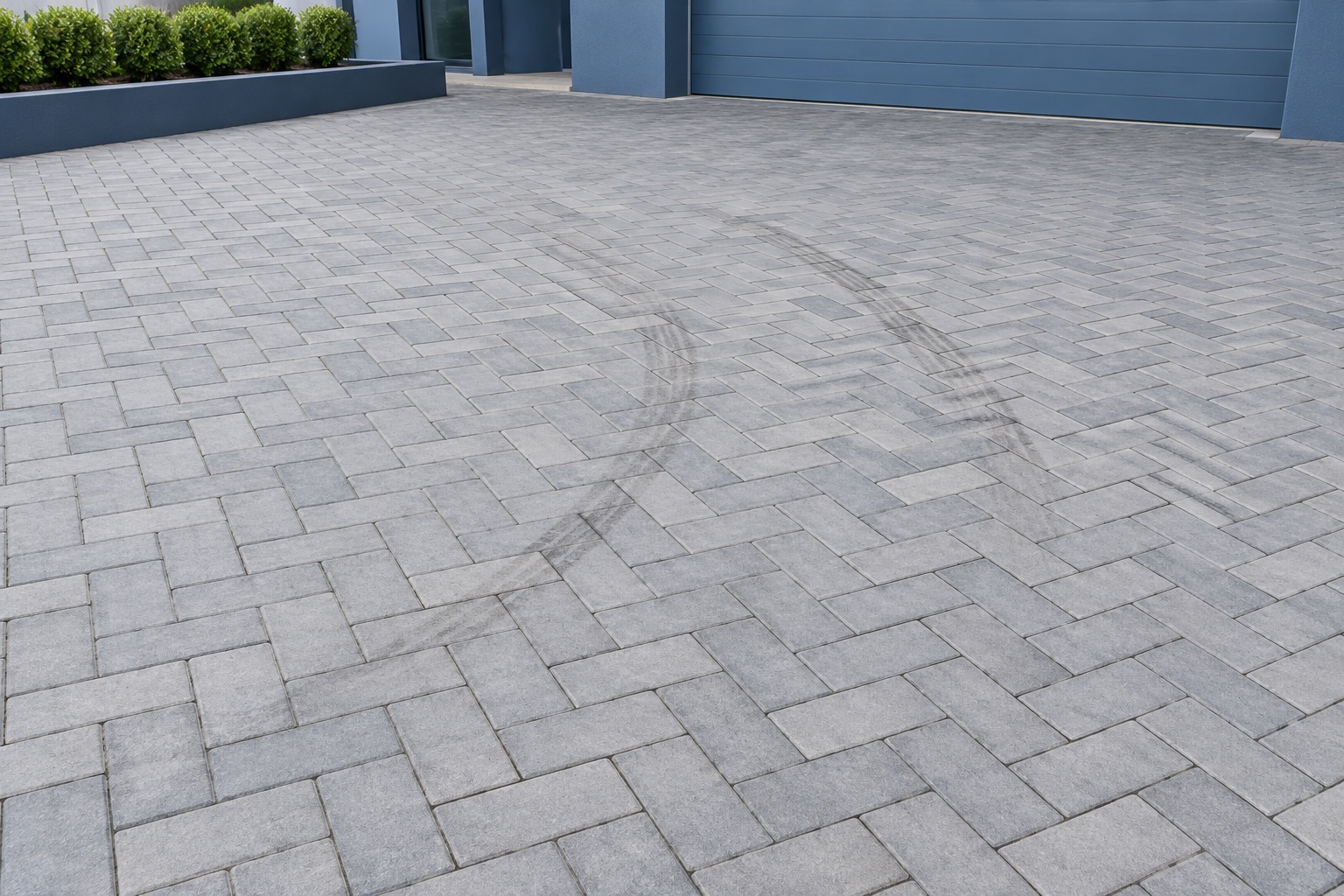
Before cleaning tire marks on driveway pavers, record where they appear and whether they return after turning or parking. A photo alone cannot establish their composition or whether they will come off. For your Broward driveway, approve a small professional cleaning trial before broad cleaning or resealing. Ask the contractor to distinguish a removable deposit from coating damage, and flag any paver movement separately. The appearance of a dark arc does not settle those questions.
The scope of paver cleaning and sealing services should explain what is being evaluated, which work is included and what still needs your approval. Keep surface records and photographs together so the assessment starts with the driveway’s history.
AI-generated illustration of tire scuffs on a gray driveway. It does not depict completed work or provide diagnostic proof.
Record the route, not just the darkest mark
A tight photograph documents the scuff, but leaves out the maneuver around it. Take an overview showing the garage, driveway edges and usual parking position, then closer views of the marked area. Keep the original files so dates remain available. You are building a record, not trying to identify a substance through a screen.
Use recognizable locations in your notes:
- Where the vehicle turns toward the garage.
- Where tires usually rest while parked.
- Whether the mark crosses several pavers or follows an edge.
- When you first noticed it and whether it returned.
- Whether parking or turning habits recently changed.
Describe what you actually observed. A mark noticed after parking is useful history, but timing alone does not establish its cause. Avoid labeling every dark area as the same problem when submitting photographs.
If someone already attempted cleaning, include the product name, any available service record and photographs taken beforehand. An incomplete history is still worth sharing. Write down what is unknown rather than guessing which coating or cleaner was used.
Separate appearance from driveway condition
CMHA’s Operation and Maintenance Guide for Interlocking Concrete Pavement distinguishes cosmetic concerns from maintenance issues involving joints, movement and ponding. Its guidance places sealer application after cleaning. The publication addresses concrete pavers.
Walk the contractor through the locations you recorded. Ask for separate findings on the mark, the existing finish and the surrounding driveway. If the proposed explanation is coating damage, request a description of the evidence and what remains uncertain. A label such as scuffing should not replace that explanation.
Keep observations of shifted pavers, changed joints or standing water on the assessment agenda. Ask whether those observations change the proposed scope before accepting a cleaning-only estimate. You should know which concerns the proposal addresses and which need further evaluation.
If the discussion expands into rebuilding or changing the layout, review our driveway pavers installation service as a separate project decision. A surface complaint should not become a replacement commitment without an explanation of why the larger work is being proposed.
Make the cleaning trial a decision point
CMHA’s Cleaning, Sealing and Joint Sand Stabilization of Interlocking Concrete Pavement covers tire skid marks, stain identification and small-area testing. It also addresses preparation before sealing and product-specific guidance, including compatibility information. These directions concern concrete pavers; do not extend them to natural stone.
Ask for a written trial scope identifying the selected location, the professional responsible and the result you will review together. Agree that authorization for this limited work does not automatically authorize cleaning the entire driveway, removing an existing coating or applying new sealant.
Set your review criteria before work begins:
- How much of the visible mark remains?
- How does the area look beside adjacent pavers?
- Is the appearance acceptable from your usual approach?
- What further work, if any, is being recommended?
- What uncertainty remains about repeating that work elsewhere?
During the review, ask the contractor to describe both the remaining mark and any change to the surrounding finish. Ask whether the recommendation assumes a removable deposit, an altered coating or an unresolved combination. Keep those explanations attached to the proposed next step. Do not approve resealing merely because the trial area looks different from the rest of the driveway.
Request photographs from the agreed viewpoint and a plain explanation of the outcome. If the contractor proposes changing the approach, ask for the reason and a revised scope before continuing. Do not turn an inconclusive trial into permission for increasingly broad work simply because equipment is already on site.
For a consultation, send Perfect Pavers your location photographs and any coating records. Ask to begin with a site assessment and a proposed trial scope; the next step is agreeing what can be evaluated before you authorize work across the driveway.
What our Broward project actually documents
Our Broward cleaning and sealing project documents stripping and removing previous epoxy sealant, re-sanding the joints and applying new sealant. Those are the recorded operations. The project description does not identify tire marks or establish a tire-mark removal result.
For a homeowner comparing proposals in Broward, its useful detail is the separation of coating removal, joint work and new sealant. When an estimate includes stripping, ask what finding on your driveway justifies that operation and which area it covers. The project is not a reason to strip every driveway with dark scuffs.
Bring any previous coating invoice to the assessment. If the record only says sealed, leave the product identity unresolved until the contractor can investigate. Ask the proposal to distinguish confirmed history from assumptions, so an unknown finish does not disappear behind a generic restoration description.
Compare the work you are approving
Use the paver cleaning and sealing estimate scope guide when comparing proposals. For this particular concern, make the marked area identifiable in the written scope. A photograph with location notes can connect the contractor’s wording to the part of the driveway you discussed.
Ask each proposal to explain:
- Whether the trial is a separate authorization.
- Which marked areas the cleaning scope includes.
- Whether coating removal is included or only an option.
- How any joint work will be recorded and approved.
- Whether sealing is proposed and when you decide on it.
- Who approves changes after the initial assessment.
Also agree how household access will work. Identify where vehicles will be kept, which entrance remains available and who will tell you when normal use can resume. Ask how weather-related schedule changes will be communicated. These are project arrangements to settle with your contractor, not assumptions to make from a generic service description.
Compare exclusions as carefully as included work. If a proposal leaves an existing coating unresolved, request clarification before treating it as equivalent to a proposal that evaluates that coating. A complete decision includes the conditions that could change the scope.
If you are comparing limited cleaning with wider finish work, request each as a separate option. Identify the boundary of each option on your location photograph, and name who will authorize a change.
Keep a useful record after the visit
Save the agreed scope, trial photographs and your decision together. Note whether you accepted the appearance, requested another assessment or deferred broader work. This gives the next conversation a clear starting point instead of relying on recollection of how dark the driveway looked.
If marks recur, photograph their location before arranging another visit. Record whether they occupy the same turning path, a usual parking spot or a different area. Include any change in vehicle use you actually observed, without assigning a cause yourself. Ask the contractor to compare the new record with the earlier assessment before recommending further treatment.
For a Broward consultation on driveway paver cleaning and sealing, share that record and explain the appearance you want to improve. The next step is an on-site review of the marks, finish and driveway condition, followed by a defined trial proposal for your approval. Use that review to decide whether broader cleaning or resealing belongs in your project.