
Pavers Ideas
Tree Roots Beside a Paver Driveway: What to Check Before Replacement
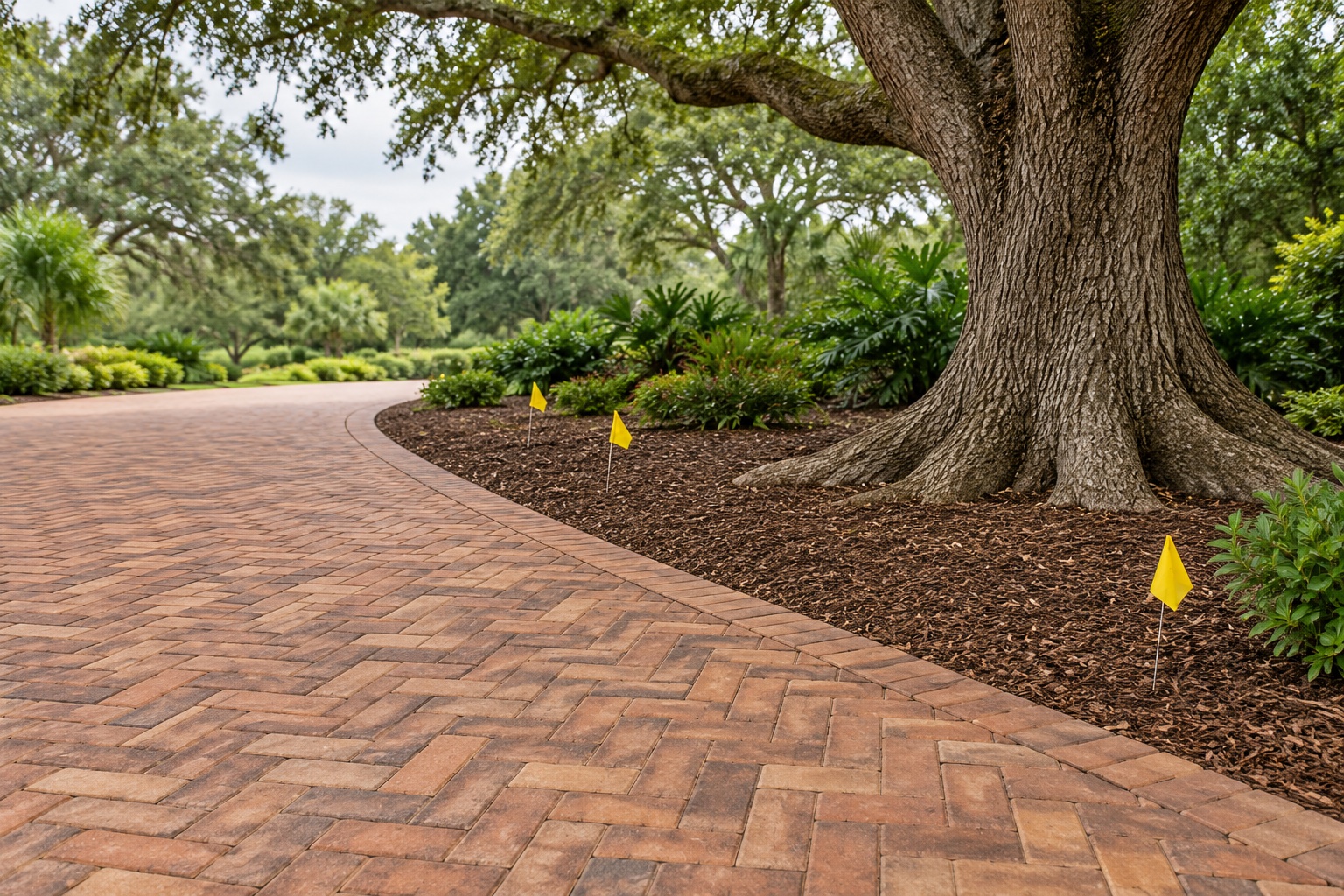
AI-generated conceptual illustration, not completed work or diagnostic proof. Flags do not establish an approved tree protection distance.
Before replacing a paver driveway beside established trees, record the surface changes and arrange a qualified arborist’s assessment before fixing the demolition or excavation scope. A raised paver alone does not prove roots caused the movement, and cutting roots to flatten the driveway should never be the default plan. Review what can stay, what could move and which decisions need separate tree expertise before committing to a layout, schedule or removal date.
For homeowners in Broward and Palm Beach Counties, paver driveway replacement planning should start with those site questions. Choosing a color comes later, once the proposed work and its limits are understood.
Record what changed before naming the cause
Photograph the driveway from consistent viewpoints and date the images. Show the uneven section in relation to surrounding pavers, the border and the nearby tree. Note whether an area appears raised, adjacent areas appear lower, or both. Describe the observation without labeling it root damage.
On a property sketch, mark the tree’s location, its visible flared base, the driveway edge and nearby walking routes. Include where water collects and where a vehicle now catches or rocks, if you have observed either. The sketch records conditions; it cannot establish the underground reach of roots.
Gather invoices and photographs from earlier patches. Identify where pavers were reset, whether movement returned and what the previous contractor actually recorded. Leave unknown causes marked as unknown. A differently colored patch may help locate earlier work, but it does not reveal what happened underneath.
Bring in tree expertise while the layout can change
UF/IFAS explains in Urban Design for a Wind-Resistant Urban Forest that structural roots help anchor trees and cutting them during hardscape repair can destabilize a tree. It discusses rerouting and bridging as possible responses to conflicts. These are options for site review, not a driveway construction recipe or proof that a proposed surface can carry vehicles above roots.
Give the arborist the proposed work outline and the history you collected. Ask what needs assessment before the contractor can define removal, excavation and rebuilding. Request findings that can be shared with everyone preparing a proposal, including unresolved questions and any further design input needed.
Keep separate the arborist’s assessment of the tree and the contractor’s assessment of the driveway. A surface repair proposal does not establish the tree’s condition. Likewise, a tree recommendation needs to be translated into a workable driveway design before it becomes a construction commitment.
Compare the footprint before choosing the finish
Ask for a discussion of the alternatives that fit your property. The existing outline is a starting point, not an automatic instruction to reproduce every edge.
Retain suitable existing areas. If the assessment supports keeping part of the driveway, compare a limited paver repair scope with broader replacement. Clarify which areas remain, where old and new work meet and whether the original concern would remain unresolved.
Reroute the affected edge. Explore whether a different alignment fits the tree assessment, vehicle approach and walking access. Review the revised outline with your normal parking routine in mind before judging its appearance.
Reduce the footprint. Discuss whether an area you seldom use could return to landscape. Consider the parking capacity and access you would give up, along with how the remaining border would be finished. Treat this as a design choice to evaluate, not a promise of tree preservation.
Rebuild within the same outline. Ask what the assessment supports and what remains conditional. Matching the old boundary does not by itself settle the excavation scope. Compare proposals on the same assumptions, especially where one leaves tree decisions to be made after removal begins.
Request a consultation with Perfect Pavers to discuss your preferred options, bringing the sketch, photographs and any arborist findings. The next step is a driveway scope discussion: identify what can be assessed now and what outside advice is still needed before a written proposal can be finalized.
Make access and staging part of the plan
In Construction Phase: Protecting Trees and Conserved Natural Areas, UF/IFAS describes how construction traffic, compacted soil, grade changes and added fill can damage roots. It emphasizes planning protected areas and involving a qualified arborist. Keeping the trunk untouched does not mean the surrounding root environment is protected.
Have the agreed plan identify delivery access, material storage and debris collection away from protected zones. Check that subcontractors receive the same plan. If a delivery cannot follow it, assign someone to resolve the conflict before unloading rather than leaving the driver to choose a convenient spot.
Discuss how household access will work during each stage. Include the route from temporary parking to the entrance and any access needed by landscape crews. Keep these arrangements in the project notes so a later scheduling change does not quietly change where people or equipment are expected to go.
Separate tree decisions from the pavers contract
Define who commissions the arborist, who receives the findings and who arranges any separately recommended tree work. Tree-removal permissions are address-specific and are not stated here. Establish who checks applicable approvals before any removal decision is treated as authorized.
Ask the pavers proposal to distinguish included work, excluded tree services and decisions still awaiting review. Identify who hires and pays outside professionals. Do not assume Perfect Pavers provides arborist services or that a driveway quotation includes tree removal because a tree appears on the drawing.
Ask for the proposal’s assumptions in plain language. A bid based on keeping the tree cannot be compared directly with one that assumes its removal. If an item remains undecided, record what information will settle it and who must supply that information. Tie material orders to the accepted layout so an unresolved edge does not become a premature purchase.
The guide to underground lines before driveway replacement covers a separate coordination task. Keep that information with the project records, but do not treat utility locating as a tree assessment or let either task disappear into a vague preparation allowance.
Agree on the pause before roots are exposed
Set a stop-and-review trigger in writing: if roots are exposed in the affected work area, pause that work and contact the designated reviewer before changing the agreed scope. Name who documents the finding, who coordinates the arborist’s input and who approves the revised work before it resumes. Do not leave root cutting as an informal field decision to achieve a flat finish.
Agree how additional assessment, redesign, crew rescheduling and return visits will be handled and charged if required. Ask who communicates the effect on driveway access and the completion schedule. An unresolved condition deserves a visible decision point, not an assumption buried in a general removal line item.
What a documented installation example can show
Our Pompano Beach driveway and pool deck installation documents base reconstruction, slope for drainage and secured edge restraints. It is a useful example of installation scope extending below and beyond the visible surface. The project description does not document tree assessment, root treatment or arborist involvement, so it is not evidence of those services or their results.
For your own proposal, ask which underlying work has been assessed and which conditions remain open. Keep the agreed layout, findings and revisions together so the crew and homeowner are referring to the same version.
Before choosing our driveway pavers installation service, confirm that the proposal addresses the tree-related decisions, retained areas, access arrangements and review trigger. Those details make competing scopes easier to compare than a paver sample alone.
Request a driveway consultation for your Broward or Palm Beach County home with your site record and current arborist advice. Ask the team to review the proposed pavers work, identify outstanding coordination and explain the next step toward a written scope. Resolve the open decisions before setting a demolition date.