
Pavers Ideas
Oil Spots on Driveway Pavers: Cleaning, Replacement or Sealing?
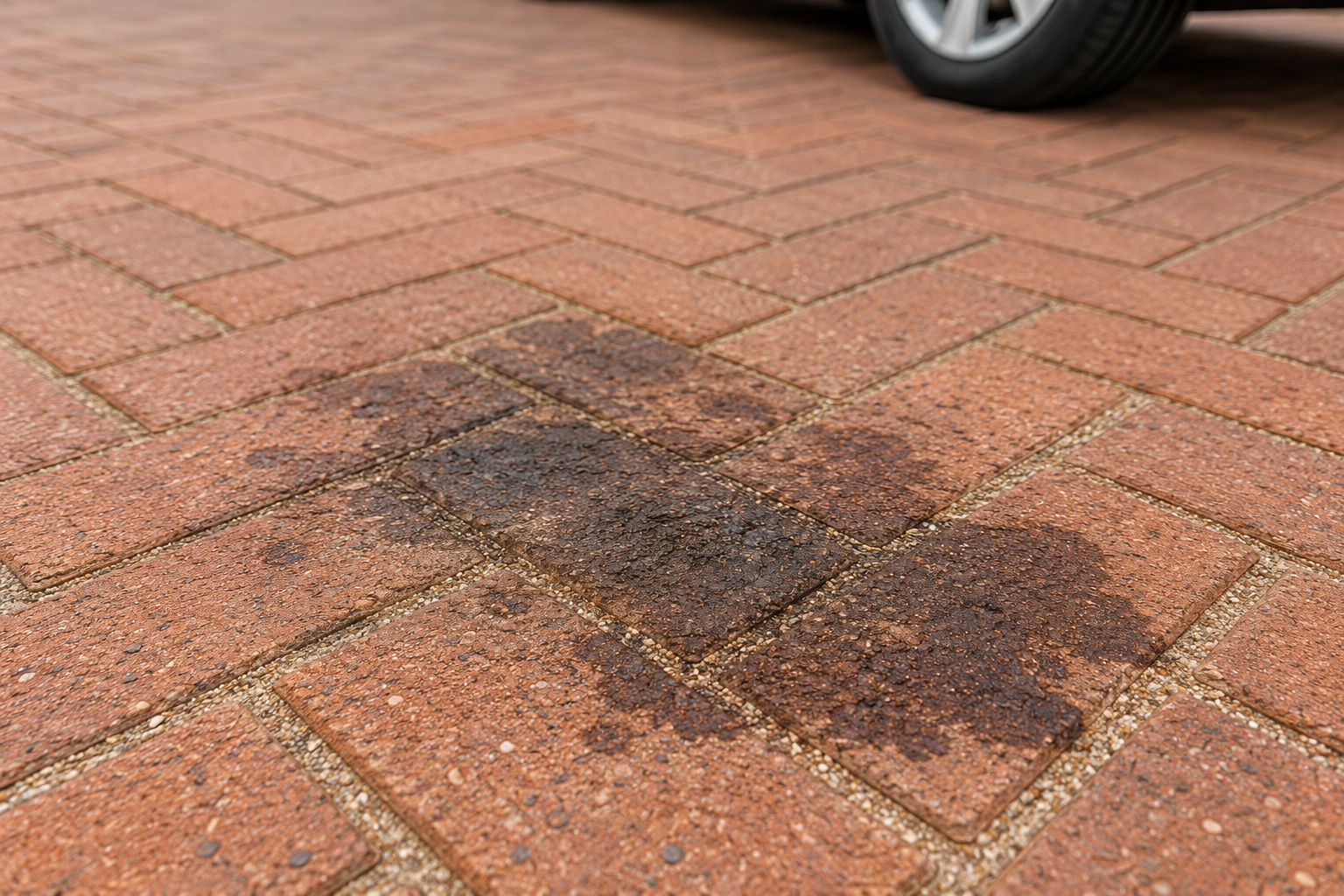
For suspected oil spots on driveway pavers, address the source first. Have an active leak assessed and corrected by the appropriate mechanic or other trade. Use a cleaning trial before choosing localized replacement, and treat sealing as a separate decision. A dark patch alone does not identify oil. For a Broward driveway, the goal is an agreed appearance and a clearly defined scope: any remaining stain and replacement color mismatch should be discussed before you authorize the work.
Our paver cleaning and sealing services are a starting point for discussing the affected area, existing finish and proposed work. Bring maintenance records and photographs so the assessment starts with your driveway’s history.
AI-generated illustration: a dark patch on terracotta-colored driveway pavers. This is not completed work or diagnostic proof of oil contamination.
Establish the history before ordering work
Record when you noticed the mark, what normally parks there and whether you witnessed a spill. Tell the assessor whether it has reappeared in the same location. Distinguish what you observed from what you suspect; a parked car in a photograph does not establish the substance.
If a vehicle is the suspected source, arrange an inspection with an automotive specialist. For another suspected source, use the relevant trade. Tell the pavers contractor whether that investigation is pending or the leak has been repaired, so the proposed work can be coordinated around it.
Gather the original material invoice, previous cleaning records and any sealer product information. Ask the assessor to identify the paver material if the records are missing. Note any treatments you have already attempted, including products applied by a previous owner. An unknown coating should be recorded as unknown, rather than assigned a product name from its appearance.
Make the cleaning trial a decision point
CMHA’s Cleaning, Sealing and Joint Sand Stabilization of Interlocking Concrete Pavement recommends identifying stains, testing products and preparing concrete pavers before sealing. Confirm product-specific compatibility. Removal is not assured. Natural stone needs separate guidance.
Before authorizing the trial, agree on its location and what you will receive afterward: photographs, a description of the observed outcome and a recommendation for the remaining area. Ask which decisions remain open. Approval of that limited work should not automatically authorize repeated treatments or a driveway-wide service.
Review the appearance from where you normally see the driveway, including the approach to your entrance. A close photograph is useful for recording detail, but your decision also concerns how the entrance looks as a whole. Ask to review the actual surface, rather than choosing solely from a contractor’s phone image.
Describe your acceptance criteria plainly. You might accept a faint visible mark but reject a conspicuous patch beside the front walk. Put that preference in the estimate. If the outcome falls outside it, pause for a revised proposal instead of allowing additional work to accumulate without a new decision.
Compare the outcomes you can accept
The choice is partly about appearance and partly about how much of the driveway you want disturbed. Compare defined alternatives, including the option of keeping the existing surface with an acknowledged mark.
| Option | When to consider it | What to agree before proceeding |
|---|---|---|
| Keep the existing pavers | The reviewed appearance meets your expectations | The work boundary and any mark you accept |
| Replace affected pavers | You prefer a local change to the remaining discoloration | Actual replacement samples, removal limits and acceptable color differences |
| Consider sealing | You want to evaluate a finish for the retained surface | A separate finish proposal, appearance sample and care information |
For a finish proposal, state whether you want to retain the current look or consider a different sheen. Ask what future care you would be accepting and whether the proposal covers only the affected area or a continuous section of driveway. Review the proposed boundary as part of the appearance decision.
For replacement, review the actual available units beside the driveway. Look at their shape, texture and color together. If you have stored spare pavers, show them during the assessment; do not assume that a matching product name settles the visual choice.
Ask for the proposed replacement boundary on a photograph. Decide whether you prefer the smallest affected group or a different boundary within the existing pattern. Neither choice should be described as invisible. Record your acceptance of the proposed color mismatch before material is ordered.
If the discussion expands to changing the pattern, borders or footprint, request a separate driveway pavers installation plan. Ask why that broader scope is being suggested and compare it with retaining the current layout.
Request a consultation with Perfect Pavers to review these alternatives. Send photographs, your maintenance records and the status of any leak investigation; use the assessment to define the initial scope and the approval needed before further work.
Separate appearance from driveway condition
CMHA’s Operation and Maintenance Guide for Interlocking Concrete Pavement addresses joints, movement and ponding separately from cosmetic concerns. It also places cleaning before sealer application on concrete pavers.
Keep a separate list of concerns you want assessed, with their locations marked. Ask the proposal to distinguish surface maintenance from structural repair. If repair is recommended, request the reason, the area involved and a separate description of the work. A general restoration label leaves too much uncertainty about what you are buying.
Agree who will review any condition exposed during removal and who can authorize a change. That gives you a way to pause, understand the finding and approve the revised scope without assuming that everything beneath the selected pavers was included.
What the Broward project actually demonstrates
Our cleaning and sealing project in Broward records removal of an old epoxy coating, re-sanding of the joints and application of a new sealant. It illustrates separate work stages. It is not evidence of oil removal and provides no guarantee for another driveway.
Use that distinction when reading your own proposal. Ask whether coating removal, joint work and the final finish are included, optional or excluded. The portfolio does not establish that your driveway needs those stages; its value here is showing why the scope should name each task.
Ask for an estimate with clear alternatives
Have the contractor identify the exact area covered by the proposal. A spot beside a parking position and the whole driveway are different buying decisions. Ask how each alternative affects vehicle access, protection of adjoining finishes and the arrangements for returning the driveway to use.
The written proposal should identify the initial authorized work, the review point and the alternatives requiring your approval. For replacement, request the proposed material and treatment of the surrounding pattern. For a finish, request the proposed product, intended appearance and maintenance information. Keep leak repair assigned to the appropriate trade.
Our paver cleaning and sealing estimate scope guide helps you compare preparation, coating removal, joint work and exclusions. Use it to check competing scopes line by line. A broad package description is difficult to compare with an itemized proposal because the included work remains unclear.
Before scheduling, name the person who will approve changes and attend the appearance review. Retain the accepted photographs and written scope with your home maintenance records. Those records give the next conversation a factual starting point.
For your Broward driveway, request a consultation through our paver cleaning and sealing service. Share the spot history, photographs and your preferred outcome. The next step is to review the surface and agree on an assessment scope, with any replacement or finish decision recorded separately.
If the dark marks follow a vehicle’s turning route rather than a drip location, review tire marks on driveway pavers as a separate assessment question.